
The Generational Deal
How we can reimagine our civic compact as a nation-state of owners in the American Dream.

This article is part of The Boyd Institute’s quarterly policy sprint on the debt and deficit. To learn more about them and the work they do or submit your own article click here. AI tools Claude and Gemini were used widely in this piece as debaters, researchers and co-editors, but the final words are all mine, though I had assistance with the hypothetical number crunching. Finally, this piece was written in mostly a haze on paternity leave with a toddler in the room and a newborn somewhere else in the house, so it’s best treated as a working draft and I may periodically update it.
The US national debt. The seemingly insurmountable challenge of our times. For as long as I can recall, it’s been in the backdrop of politics on slow news days, usually dragged out by the media more or less often based on how they like the current political administration. So, of course, nowadays, the national debt is discussed often. It’s usually cited in the context of how Social Security followed shortly by Medicare are set to incur automatic cuts (not run out, that won’t happen). That makes sense, as those are the primary drivers of the national debt. In fact, as our welfare programs’ poor design is what is bankrupting us, this essay will primarily focus on their impending fiscal crunch. (The national debt is an immense problem due to surging interest costs, of course, but we can’t even begin to fix that beyond engaging in financial repression a la the 1950s through 1970s, without addressing our welfare programs, chiefly Social Security and Medicare.)
Even with a fifth-plus of Social Security less than a decade away from shortfall and Medicare at maybe 11%, we and our political class seem to dither. Many proposals will be made for this contest to fix what’s breaking our national budgets. What I think is darkly amusing is that the fix is simple, as this author pointed out recently: You can go to the CRFB website and play around as much as you want, and yes, a slew of seemingly small-ish changes solves the problem. I think that the simplicity of the fixes actually makes it easier to ignore—much like how we use purchases of exercise equipment to make us feel like we are getting healthier rather than actually putting in work, we procrastinate by trying to think of grandiose, sweeping alternatives to the boring, inevitable, straightforward pain of higher taxes or reduced benefits, or both.
Such is the way of things—in general, humanity isn’t great at preventing crises when large-scale, likely painful measures are required in advance. We aren’t good at doing it even when we know full well any such crisis would be far worse than the prevention. We only do it when the crisis is here, in all its usual brutality.
But we can do better. We must. Our problems are not to be solved by a zero-sum mentality; we have to be more creative and bolder in seizing this challenge to reimagine the breaking American welfare system, rather than simply trying to patch up a failure. We must forge an explicit, new, generational compact—a Generational Deal.
You can’t spell cliff without fiscal
FDR said, “I guess you’re right on the economics. They are politics all the way through. We put those pay roll contributions there so as to give the contributors a legal, moral, and political right to collect their pensions and their unemployment benefits. With those taxes in there, no damn politician can ever scrap my social security program. Those taxes aren’t a matter of economics, they’re straight politics.” - Gulick, apocryphally Roosevelt
Any way you cut it, the numbers are grim. They’re not even really graspable at this point. As of this writing in June 2026, the US national debt is over $39 trillion; it’s roughly 120% to 124% of annual GDP over the past few quarters; and our interest expenses are about $2.8 billion - per day1.
These numbers are so abstract and large they feel fake, which is why I think handwringing doesn’t really seem to affect people. In fact, it’s rather astonishing that we haven’t seen outright riots from the majority of millennials about how much Social Security takes from their paychecks to go to a system that I think not a single one of my peers believes will exist in the future. Stunning altruism, indeed (it’s why we’re the Hero Generation, right?). But big dollar amounts when attached to deadlines tend to have more immediacy and tangibility to them, which is why we see more and more headlines about how in roughly six to eight years, funds will be tapped and there will be an automatic cut of at least 20% to Social Security benefits2 and Medicare probably in that same timeframe sees an 11% shortfall3. And yes it is the olds, primarily. Thanks to demographics, by 2036 both Social Security and Medicare are projected to have outlays combined surging past 10% of annual GDP, the former close to 6% - trillions upon trillions of dollars4.
It’s almost too easy to sniff out a vein of preemption about the online lambasting of boomers across so many different political arenas and segments, when we think about those shortfalls. The next few years are going to see significant argument volume about how we should just not worry about this and the old and/or sick can deal.
However fair or charitable that argument is doesn’t even need to be addressed, because it misses the point: Even if we don’t do much, interest expenses are gonna double in the next decade. Then, they will probably get worse, because barring an AI miracle (no clue, still dubious) or the feds and state governments suddenly realizing that maybe all regulations aren’t sacrosanct (won’t happen), or a surprise baby boom (definitely not), demographics will worsen further and the US economy will limp along with a millstone around its neck as it heads toward a fifth of government spending goes just to interest payments, and not in an ostensibly pseudo-exercise way.
It’s very important to note which drivers are the worst. Medicare is currently projected as the fastest-growing entitlement program bankrupting our country, although much of that is due to the insanity of our healthcare costs. Medicaid is slowing down somewhat thanks to the recent cuts and reform, but it contributes a fair amount. A fellow contributor to this contest, Performative Bafflement, wrote a great piece primarily addressing the healthcare side of things, and I don’t have much to add to much of that author’s critique, beyond this: What we should do is sunset Medicaid over a long-enough period of time that it can be encouraged to evolve into state-level replicable, improved, local-catering models; what we will do, of course, is reform, not sunset, because it’d be political suicide. For both, of course, we have to reform healthcare costs or even the Medicaid cut won’t alleviate things entirely.
So in short, we are in for some pain. And if you think you’re not one of the “we”, buckle up, as those heightened interest payments mean funding for other services begins to fall eventually, and/or a value-added tax begins creeping into various places.
What to do?
Deciding on an approach to argue for in this piece was hard. Other entrants in this contest wrote great pieces and made cogent, interesting points, e.g., the velocity of capital or embracing further growth. Some common themes emerged, and I argue for a combination of similar approaches, albeit with different tactics.
The only way to address the US fiscal solvency is to embrace a three-pronged strategy:
Establish a permanent institution to run a pool of capital that can survive decades if not centuries with the sole goal of eventually funding as much as possible the eventual national-citizenship 401k-like combo account that will augment if not replace Social Security eventually
Stop the bleeding - there was no way out despite all my tinkering with the various tools and models for funding all of our spending, especially healthcare, without reform or outright cuts. I simply do not think reform is in the cards until our political parties can collaborate better, and it’s gonna take a decade to get rid of the stench of both the rightwing fringe and leftist progressives. Tactic: Embrace trims and reforms to Medicare primarily in site, coding and payments transparency.
Adjust incentives to build a better longer-term system of federal devolution, and embrace the E.F. Schumacher ethos of small is beautiful, because we will always run into this problem time and again when the giant federal pot of money funds too many regional or state-level expenditures. Specific tactic: taper federal funding of Medicaid over a decade in tandem with aforementioned tourniquet of reform.
I want to stress that the sovereign wealth fund will not fix insolvency—only the tactical short-term fixes can do that, before we embrace a much more honest, useful setup for Social Security funding and transition than the Ponzi-like pay-as-you-go scheme.
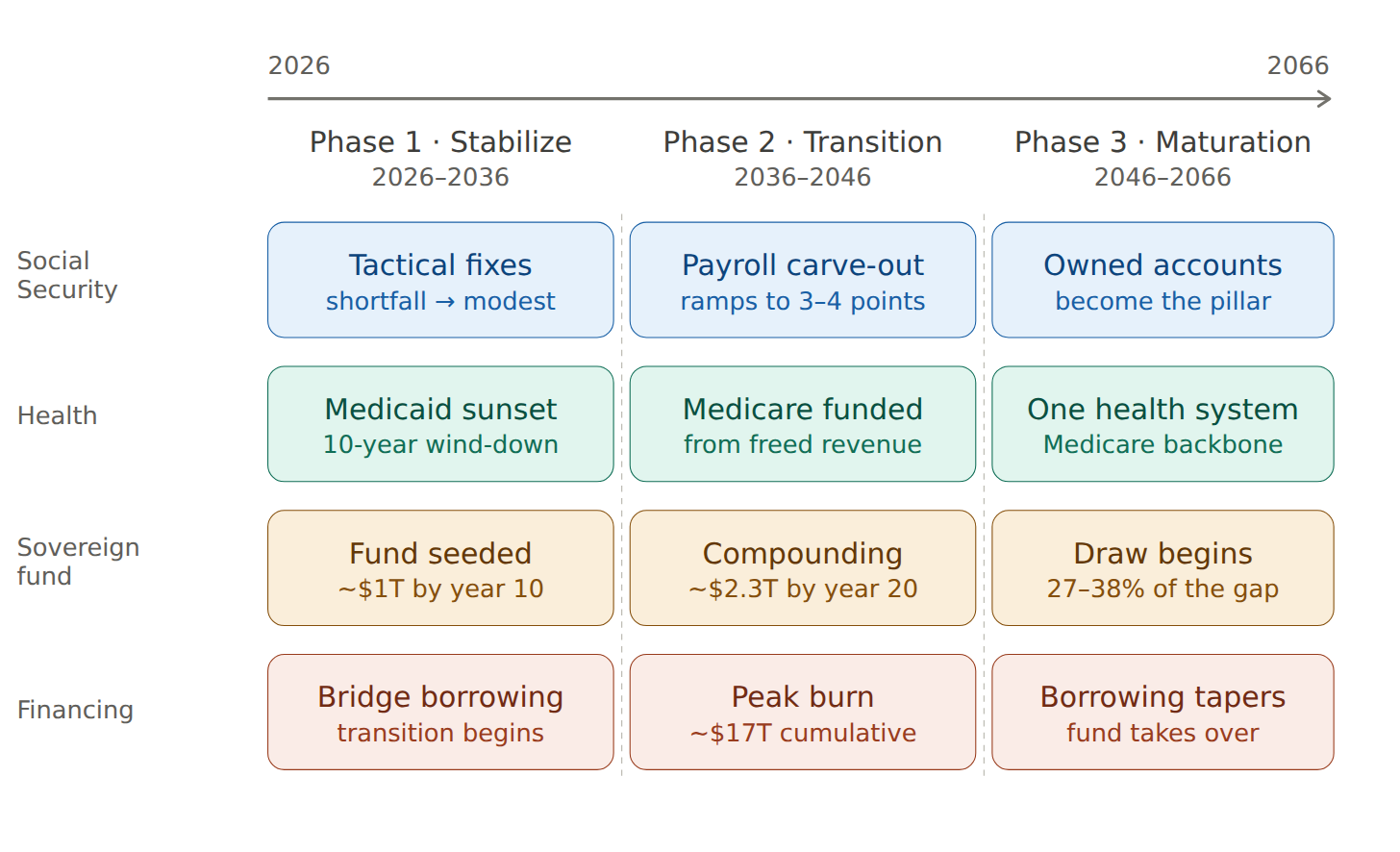
Yes, based on recent history, even a small tapering for Medicaid is going to be painful and unpopular. A sovereign wealth fund will take decades to become a main pillar of funding. Social Security cuts, however small, are going to be very unpopular, though it remains to be seen what happens between boomers’ and retirees’ higher voting rates versus aging millennials realizing what’s happening to their paychecks. But we have to do something. Demographic decline is most likely irreversible now and on a seemingly longer timeframe could be even worse. We are headed toward a 2:1 worker-retiree ratio. The world’s population may peak by the 2040s to 2050s (to be clear, that’s my very pessimistic view, most authorities presume it’ll be around the 2080s or earliest 2064), then begin to contract, breaking all wealthy nation welfare state programs founded on expanding populations.
So we have to be realistic, and sell our cuts with a pro-growth agenda of energy and infrastructure investment and deregulation and favorable tax policies, all of which is already beginning to happen. But most of all we need a much more alluring, bigger dream to sell this to the American public—and that is the promise of an actual retirement system invested in productive assets that each person can own and view, rather than a murky pay-go pool of dwindling capital. This is not new. It is basically an aggressive version of what the W. Bush administration proposed and tried to pass in the mid-2000s, which recent analysis shows would have, had it started in 2005 at $83 a month in contributions, netted anywhere from approximately $50,000 to over $100,000 for workers.
What does the US sovereign wealth fund look like?
There are only a few historical models for a well-run fiscal state that can work for what seems perpetuity, at the scale of the US. But in each of these, due to political gamesmanship across cycles, there is a permanent source of capital due to either investment, natural resource ownership, essentially a critical mass of assets backed by force, and outright force. A few historical examples:
The US’s own: The Alaska Permanent Fund. Created in 1976 via constitutional amendment by the state, and cutting checks since the 1980s to every man, woman and child in the state that’s eligible. People can only squabble over the income streams.
Norway: About $2 trillion now, borne from very smart people realizing they needed to cash in on the North Sea oil boom and thus they seeded the fund in the 1990s and now it funds boatloads of nice welfare stuff for Norwegians.
EDIT: Feedback has indicated that I missed probably the best example for my argument: Canada’s CPPIB, which is transparent, invests widely in alternatives, and so on. Apologies to our neighbors to the north.
Beyond blessings of natural resources, Singapore’s GIC is an interesting playbook: “…the state utilizes a mechanism called the Net Investment Returns Contribution (NIRC), which allows politicians to spend up to 50% of the long-term expected real returns of its reserves to fund current infrastructure and education, while the remaining 50% is automatically plowed back into the engine to compound for future generations.”
The actual investment strategies are pretty clear: go longer term, hedge with bonds, etc. Fiscal discipline is paramount. And most importantly, you can’t touch the principal and even ideally most of the income streams. This is why I think the establishment of the institution to run a sovereign wealth fund for the US is the most critical design aspect, and actual long-term investing like those done by endowments is a simpler problem to face. Seizing the funds will always be a temptation for any administration, which is why it’ll be much more politically difficult to do so if they are earmarked solely for eventually funding as much of a national 401k tied to each citizen. Ideally they’d retain the political impregnability of Social Security by doing so.
Dream team
The institutional setup of such a fund is the most critical part of any sovereign wealth fund. Any pool of money that could be administered by an agency that is subject to appointments by any elected politician is going to run into too much political risk and, much as we’ve seen with fiscal sleight-of-hand for welfare programs, purloinment for other purposes. We need unelected administrators, probably around a dozen or so (if it was good enough for Jesus, it’s good enough for me), that will be selected via a per-firm lottery among the top 12 asset managers by AUM every three years. The lottery will be randomized, compensation could be an option, but it’ll be marketed as an honorable tour of duty serving your country. The continual refreshing of the teams means that continuity and experience will be sacrificed in exchange for less bias and incentive risk - but there can be tweaks to this model as long as no exposure to political risk or gamesmanship occurs.
The fund’s tactics itself will be run by a customized quant algorithmic set, with an AI agent addressing the actual trading and deployment of capital as needed, within the broad parameters of strategies set by the team. It will be a blind pool of capital so that the team does not know what securities the agent is investing in, nor any other information that could overly distort market operations or induce insider trading. This introduces significant potential errors in asset or security selection, but that’s what the team is for, honestly, and it’s not that different from managing an index fund. I don’t think this system will be perfect, but the whole goal is to reduce the fiscal impact that a massive wealth fund could have if it backs certain companies. That said, there are ways to get around this, e.g., just investing in other funds, seeding across multiple vehicles, etc.
Big potential problems here, of course: 1) if it’s a blind pool of capital, what can we do with accountability? Well, the accountability is the turnover in governance. 2) Isn’t it a conflict of interest for the board to be staffed by people working formerly at firms whose index funds would be bought? Sure, but that conflict of interest already exists, and if it’s from 12 different firms, I think you’re about set. (Caveat/edit: a fund this size moves markets no matter what, and a permanent multi-hundred-billion bid pushes prices, so we gotta mitigate somehow: broad passive indexing, hard per-issuer ownership caps a la Norway, and slow scheduled deployment. What I'm actually after, then, is execution secrecy—dark pools, no live tape—rather than a genuinely blind board, and you can have the former while still letting trustees and auditors see holdings on a 45-to-90-day lag, which is exactly what Norway does before it publishes every position annually. So I'll keep the blind-pool instinct here as my gut preference, but concede it's probably one anonymity layer too many.)
Financing tactics
How are we going to seed the capital necessary for this fund, presuming that the above institutional setup could even work? Well, there are a few ways, and here is a smorgasbord of tactics before we get to some estimates:
Issue centenary bonds or other bond variants like consols or floating-rate notes: Lock in fixed rates for 50 to 100 years to eliminate refinancing risk, similar to the Argentina bond launch where they got subscribed to about $10 billion in potential demand. If they could do that, what about the US? Sure, Argentina defaulted, but that is what they do. The US would see much more demand because the US hasn’t (yet) defaulted, that’s the point.
Billionaires’ vanity: Get a $1 billion pledge from every billionaire in the US to be paid in a period of three years and in return they get the Carnegie treatment - X number of public works and portions of the proceeds for set numbers of years named after them, monuments, etc. Yes, this is ludicrous to ask, but I think it is dumb enough it would probably work, especially as the richest tech moguls age further and realize they have no Carnegie-level equivalent to go down in history.
Tariffs: Hate to even bring them up, but honestly, I think they are an undeniable reality in a world that will grow only more contentious and fearful as demographics break down welfare states, and zero-sum mentality sets in. That said, a small flat tariff makes a lot more sense than whatever the tomfoolery occurred thus far in Trump 2.0.
Natural resource tapping: We could definitely open up federal lands in the American West to mining in our much more environmentally friendly fashion than in say China or Africa, pop some lithium out of the Salton Sea or elsewhere, and the SWF could take equity stakes of minority shares, nonvoting, to get a stream of cash. Potential projects could include: The Salton Sea, Thacker Pass, Mountain Pass, Resolution Copper Project, etc.
Even with all that, here’s the reality. We are only going to get about $50 billion probably from the billionaires, and eventually, several billion in warrants’ upside in equity from the mining projects (we don’t want to take dividends regularly, probably due to undue influence and other risks, plus those projects will take a long time to pay out anyway), everything is gonna take decades, and I mean decades:
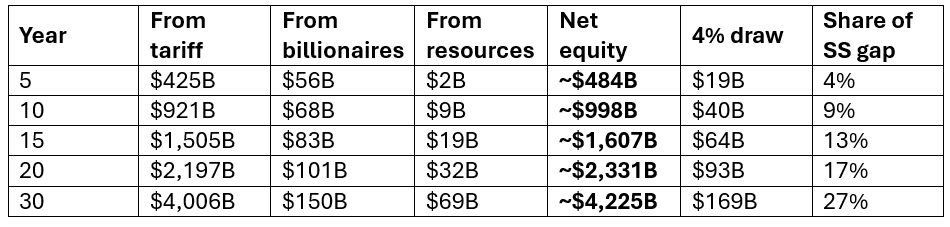
So why even do this sovereign wealth fund? Here is where we need it as the hook, the selling point for the public to embrace a new generational compact. The sovereign wealth fund is the reward for the current prime-of-life working generation in their 30s and 40s to have their children’s and their children’s children’s US national 401ks topped off by the fund when they need it most. It is the new Generational Deal. The New Deal got us in this mess, thanks to FDR’s cynicism. The Generational Deal will prevent the backlash against boomers from worsening even further.
Yes, it will take pain on the boomers’ part, which we will get to shortly, but it will also require a painful transition for millennials as their payroll taxes continue to vanish into Social Security’s current benefits, and then we up some further taxes to map out the transition to an individualized 401k for every citizen that has been paying into this Ponzi-like scheme.
Embrace the pain: Transform Medicaid and pass short-term fixes
The extent of the reform needed for Medicaid seems like a brutal proposal. Medicaid funds probably more than half of nursing home residents in the US, for starters. Why cut for such vulnerable people, even marginally? Because we simply can’t afford it all. Either we reform our healthcare system by adopting probably a Swiss model, or we cut.
But if we buy ourselves time, I think we would be surprised at what happens. Rather than at the federal level, at the state level, it is fairer and more realistic for voters to decide what additional taxes they are willing to pay to fund elder care. If the federal purse is removed gradually, states have a decade to figure out a painful but necessary transition. Regardless, effective, swift reforms will have to occur. For decades now, Medicaid overspending has masked that we treat elders and seniors largely pretty shabbily in crappy living conditions as we have figured out how to extend but not improve life in its waning (note the conditions cited in the aforementioned Performative Bafflement piece). We must reform long-term care insurance, deregulate housing so elders can live with families, improve incentives for charitable contributions, and more.
As for the reforms and slew of cuts, here’s a snippet of the roster of what would need to occur in the shorter term to bridge the gap:
Lift the payroll cap. I hate to do this one, as it taxes precisely the most productive people in the US that will and should revolt at this hike—with perhaps the options currently proposed in some circles to instead resume comp just above $250k a year or only above $400k a year, e.g., the Larson “Social Security 2100” design that exempts everything between the cap and $400k, with the gap eventually closing over time. That last is fairest and most politically popular as it defers the rise, but again, it’s worth stressing that unless we up the benefits for those paying far more into the system, it is a pure wealth redistribution technique that thru typical political sleight-of-hand gradually disappears, so that all wage income becomes taxable, i.e., the taxable maximum rises with wage growth but the threshold does not.
Cost-of-living adjustments to chained inflation rates. $115 billion on the low end, maybe $260 billion per decade as estimated elsewhere?5
Benefits cap for high earners and/or means testing. The Six-Figure Limit is popular for a reason, estimated at $100 billion to $190 billion over a decade6 , but it is somewhat duplicative with means testing, so we would do an amalgam or some type of clawing back benefits from high earners
Medicare Advantage competitive bidding, and weakening of coding intensity. Gets us up to hundreds of billions, estimated78—given that Medicare Advantage currently does the risk-adjusted based on patient illness levels, we gotta cut down on overdiagnosing of multiple codes. We have to cut, in short, the gap between how sick MA patients are recorded to be versus they actually are, as care providers are incentivized to max the former.
Site-neutral payments. Price the service, not where it’s done, whether surgery center or outpatient departments
Eliminate quality bonuses that are based on easily gameable ratings
Etc. As noted above, we don’t need to completely axe Medicaid, but we must trim it to ensure Medicare remains solvent—a trim, not a big cut, and arguably more important as a first step toward devolution. If we corrected coding-intensity overpayments and fixed quality bonuses, for example, or switched to a per-category cap at inflation, we could potentially get to over half of Hospital Insurance’s 0.56%-payroll gap (Trustees report, 75-year) with no coverage loss. Medicare’s hospital fund is short maybe $193 billion per Congressional Budget Office and insolvent in 2033-2040. Just correcting Medicare Advantage’s coding overpayments and its gamed quality bonuses closes most or all of that on its own, and nobody loses coverage. Even a soft per capita cap frees several times what Medicare actually needs. So yes, cut Medicaid to shore up Medicare, but that gets the emphasis backwards: Medicare mostly fixes itself by paying the right price, and the Medicaid money is really the first much-needed step toward devolution.
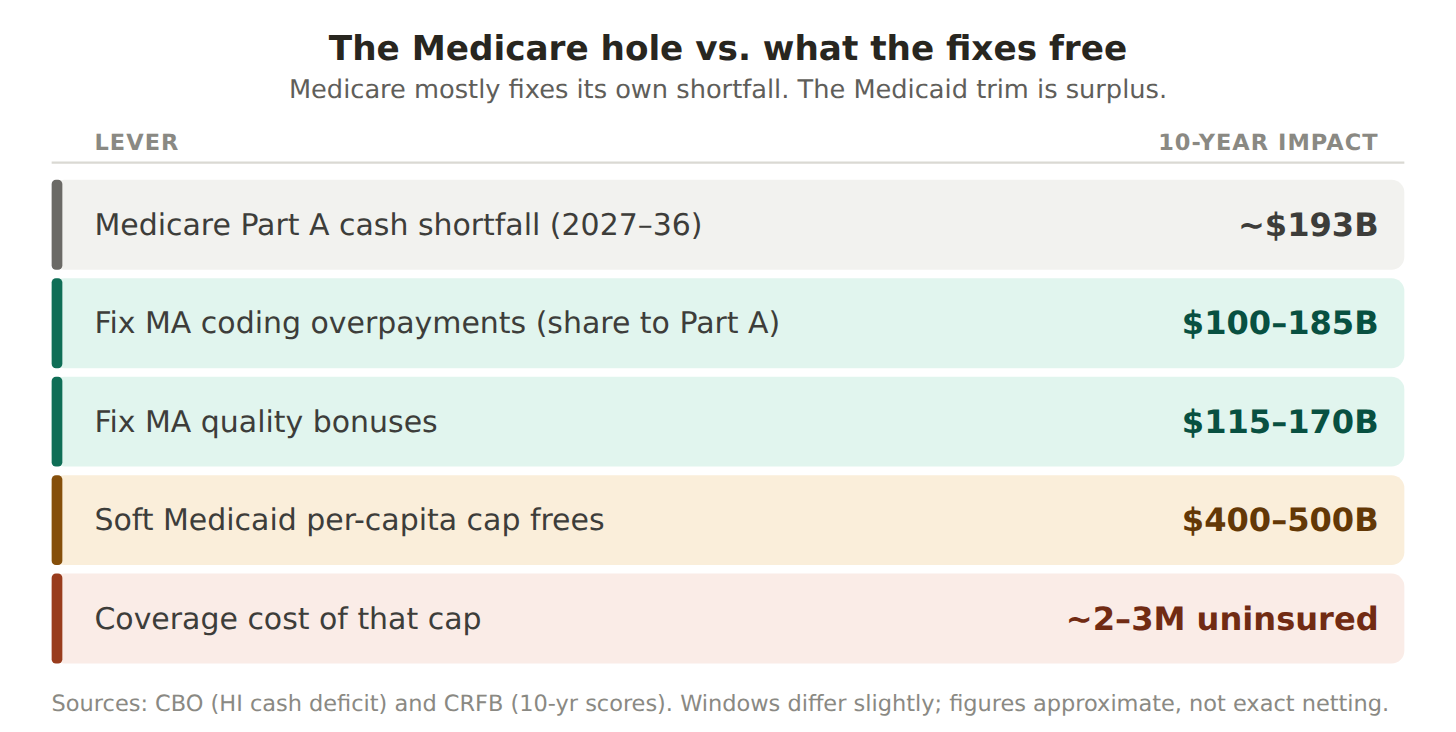
It is also very much worth stressing that these “cuts” in the vast bulk of all the healthcare budgeting woes are not actually cuts. They are fixes. They are corrections to overpayments. They are applications of common sense to outright abuse and gamesmanship by poorly incentivized to plainly nefarious actors to extract as much from giant pots of taxpayer dollars. Goldman Sachs may be the “vampire squid wrapped around the face of humanity, relentlessly jamming its blood funnel into anything that smells like money” (thanks Matt Taibbi for that great phrase) but that firm’s shenanigans are nothing compared to US healthcare’s vast hive of bloodsucking ticks that happily feast on the lumbering, weakening giant of American healthcare tax dollars, poorly designed limbs askew and organs bloated from carveouts and exemptions.
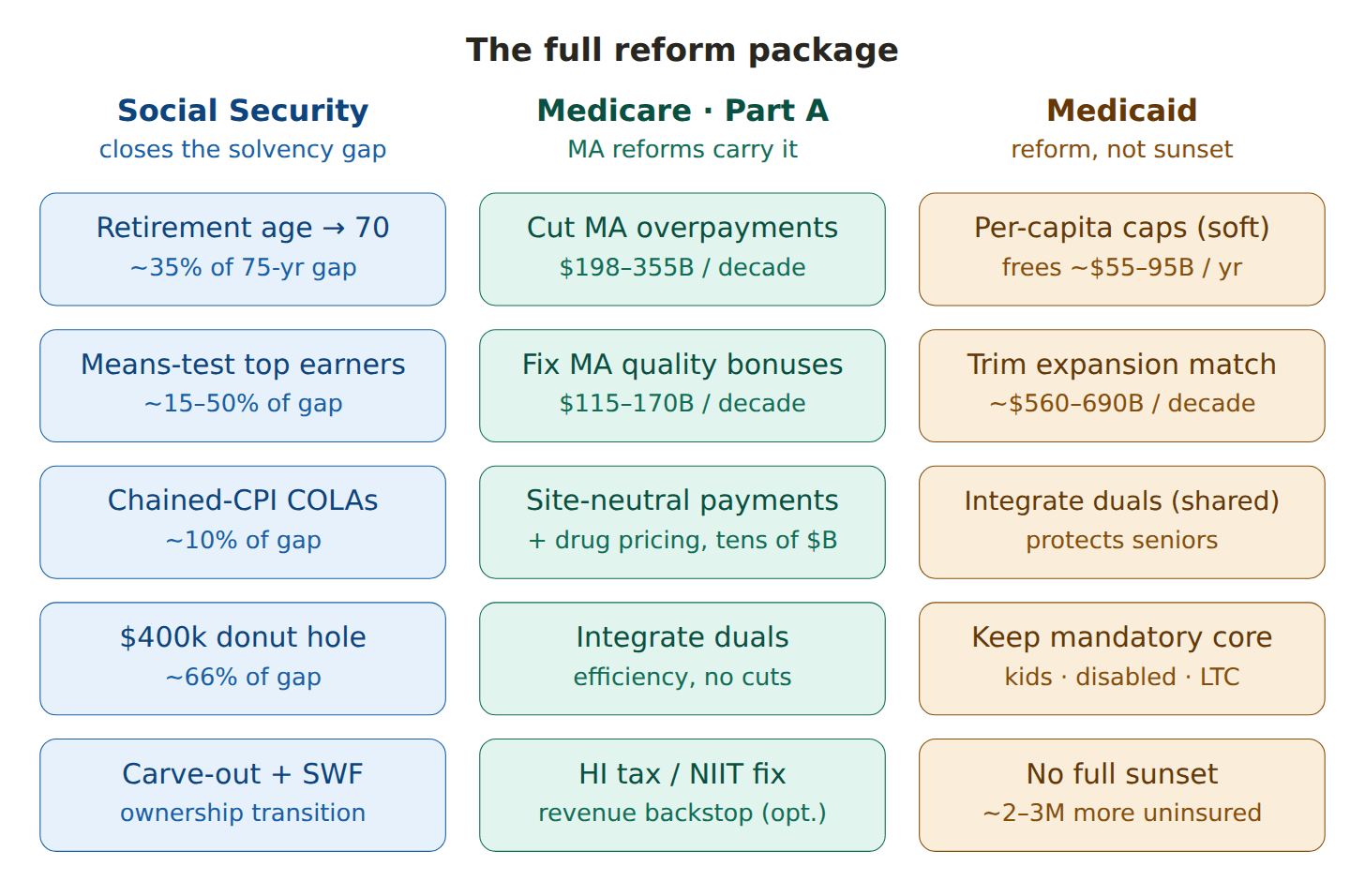
These are all estimates. I could spend days checking the math, but as much of what the CBO and CRFB does, not to mention corporate quarterly reporting, it’s a bit to a lot made up. But you see the point. The biggest lever is the discipline of cutting Medicaid to more than shore up Medicare, though of course in the bridging interim of the next decade or so, there would be some shortfalls necessitating the fixes summarized below:
Guardrails for the future
Even if we do all that, what’s to say that the SWF doesn’t end up growing that much in the future, and if demographics worsen even further, we face a similar issue down the line due to other unforeseen cost ramp-ups? Moreover, how do we sell such an unpalatable set of reforms?
Well, this is where we have to leverage incentives. Even if we weren’t facing a crisis, I’d argue that Social Security’s design, for starters, is inherently broken. I’ve paid for well over a decade into a blind pool of money that is divvied out right now, with just a government guarantee, not even a contract, that I’ll be covered similarly in the future. This is a hard deal to stomach.
Like with much of what is wrong with the world, the root of it all is a poorly constructed set of incentives that doesn’t align with human nature at all. The above reforms gesture at the outline of broader guardrails that could help the US never fall into this trap again:
Embrace funding devolution, over a period of adjustment, from the federal to the state: We must avoid funding constructs where massive streams of taxpayer dollars flow into a convoluted, opaque pool of money that then is paid out instantly, both based on differing sets of rules and obligations and assumptions. No more pay-as-you-go schemes. No more ratings trying to be omniscient at the federal level. The original intent was laudable to some degree—the federal level should concern all citizens, so thus, since we are all going to get old and sick at some point, we should all fund programs that will help us all out. Here’s the issue: individual constituencies are incentivized to maximize localized benefits, while costs spread across all taxpayers. This is why the Medicaid per-capita cuts are so important, because they could illustrate how it is more powerful for a state to own accountability across its own programs rather than murky ownership in co-funded projects. It also shows the importance of federal action occurring only for countercyclical purposes—rather than blowing out our national debt in ostensible peacetime just to make our overpromises of welfare work, we should have been hoarding resources to survive the next depression. We have spent the past several decades slowly accruing federal power and funding over the states, which we must reverse to some degree, as the experiment is not playing out well in terms of accountability or prudence.
Different states will have to operate with much more constrained budgets than others, at first. Much like we already see in action, states that encourage entrepreneurship and lower costs of living will eventually see population shifts and their tax bases grow. Such a devolution will accelerate that process, which could help ease bipartisan consensus rather than partisan bickering that persists poisonously for decades. Heck, embrace my favorite wild idea of normalizing counties seceding to neighboring states to force state politicians to cater to voter needs and track spending of taxpayer dollars more.
Incentivize a sense of citizen-ownership: It’s not trivial to argue that one of the key foundations of the Western European explosion in success in the past several hundred years was the emphasis on private property rights. Governments have been able to leverage national pride to sometimes horrific extents since. But I think it’s pretty clear to anyone that we live in a time of distinct conflict of identity across the US. We need to reforge a sense of belonging, involvement, and civic pride, at the national level, beyond the classical bonds of culture and traditions at the familial or communal level. Forging a new pact that is founded on citizenship explicitly getting you ownership in the major fund of the nation that continues to accrue wealth for future generations, maintaining a massive pool of permanent capital, will go a long way toward incentivizing a fiscal, hard layer atop all the critical soft ties that make up a cohesive community.
Loyalty and continuity in civic ties: Explicitly tie the transition between generations as part of the claim to greatness that the Greatest Generation so successfully self-mythologized and that the boomers and every generation since has abjectly failed to do so. Generational theory is at best a somewhat useful heuristic, but there is no getting voters of, say, my age at mid-30s to buy into this without a promise of a light at the end of the tunnel. I’ll be damned if I inflict this Ponzi scheme on my kids if there’s a chance of avoiding it, in short. The millennial generation gets to dub this their New Deal, their Generational Compact, where, despite the fecklessness of their elders, they would not leave them out to die alone, impoverished. They would close the gap, change the system, finish the course. And by the time we hit 70, we have finally begun paying into our own national 401ks, get the basic Social Security benefits, and our sovereign wealth fund writes us a check every year. Medicare is a different story, which should merit a wind-down into an individual citizen’s HSA, but I’m skeptical that would happen.
The American melting pot is at a troubled mid-meld stage similar to the 1890s-1910s. Nowadays, we have no crisis-forged, unifying narrative. We got closest with the Obama campaign of 2008 that tried to capitalize on multiple narrative threads but that was squandered/foundered on the Sophie’s choice that is the US healthcare lobbying system. We need to summon historical cyclical narratives: Agonies of economic dislocation and warfare like the crises of the 1840s through 1850s culminated in the Civil War; Reconstruction and massive growth plus the closing of the frontier powered into the 1890s; then urbanization and WW1 sealed the sense of America as the emerging superpower, and so on. We need a Generational Compact that ties both aging and midlife and emerging generations together, and this would suffice neatly for doing so, for a generation that I think has always felt a bit adrift for not having a great struggle. Millennials didn’t have a Great Depression - we had a Great Recession. We didn’t have a glorious big war —we had the forever wars. We didn’t have the infrastructure buildout of tangibility—we had the software explosion. But… we could have our defining moment as the most altruistic generation in human history.
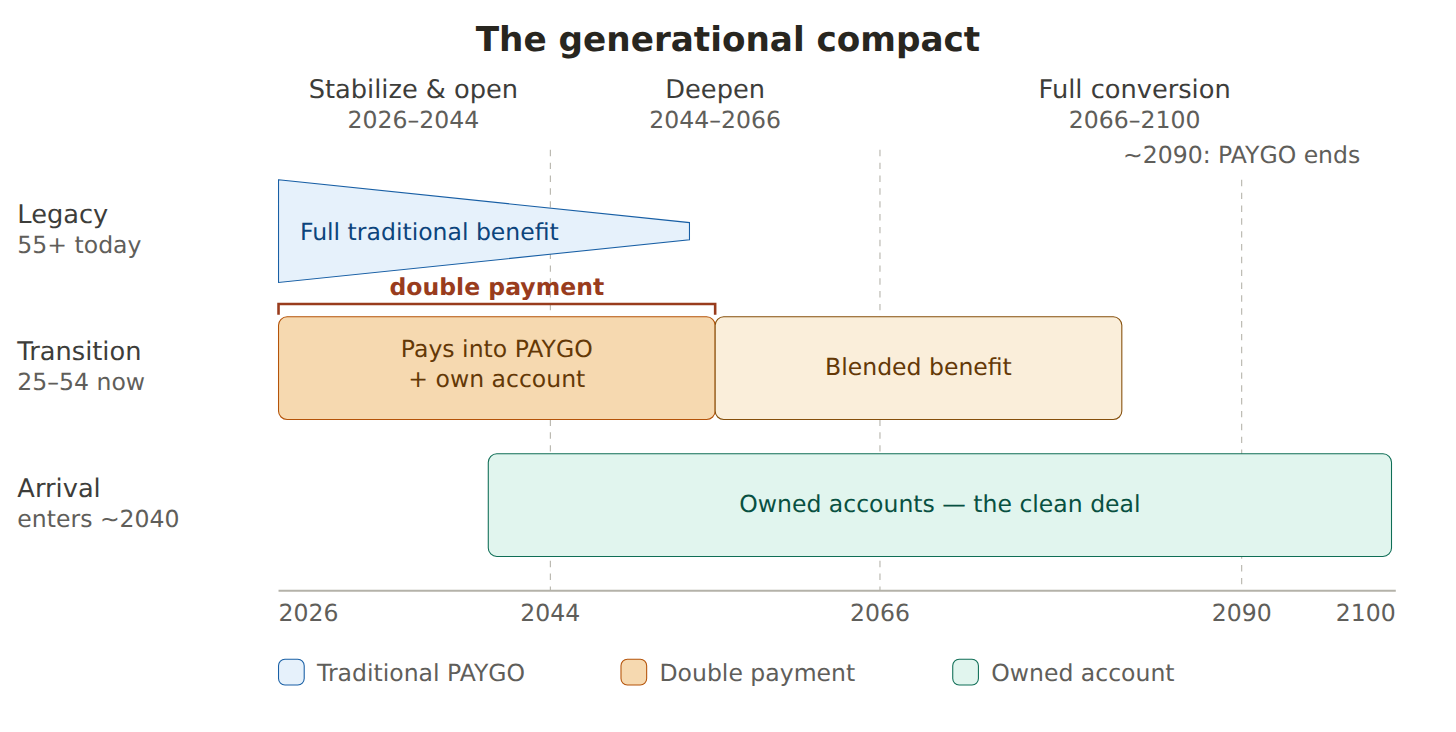
Here is why I think that would incentivize everyone correctly, even in our fraught moment (and ignoring the crazies on both the far right and the far left):
Phase 1: The legacy generation of about everyone 55 years or older now keeps traditional benefits in full.
Phase 2: Those of us aged 25-54, approximately, well, we are kinda screwed (but I think we knew that anyway). We fund that previous generation’s legacy costs, then contribute to the national 401ks, then retire with reduced payments based on our years paying in under the old system, but get our new account balance.
Phase 3: The arrival generation, of newer entrants, get owned accounts contributed to, from every paycheck. Every citizen gets a 401k, separate from work. This is for them.
With luck, the owned accounts could become a dominant vehicle by the 2050s, when demographic math could be even worse, and thus, we’d face another crisis as millennials get older.
$17 trillion. A staggering sum. That's the honest price tag of the transition, the cost of running two systems at once while my generation pays the old one's bills and funds its own. Anyone selling you a painless version is lying. The market risk is real too, though target-date funds blunt it short of outright calamity. So is the coverage hit, as the poorest and sickest are the ones exposed if states and charity don't fill the gap. I won't pretend those away. The bet is simply that a defined, owned, inheritable account beats a murky pool of IOUs I already don't believe will pay me—and that it's worth a generation's pain to stop handing the same broken deal to our kids.
At a certain point, I detest a paternalistic government as much as anyone else but if we maintain taxes at that level (with luck the sovereign wealth fund ends up in about 80 years enabling us to cut taxes across the board), I’d much rather it be mandated into an account I own and then can manage, rather than into a murky morass of the Social Security slush funds.
Gotta do something/A cynical coda
There’s a quote from The Magnificent Seven, one of the all-time great Westerns, that feels apt:
Vin: Reminds me of that fellow back home that fell off a ten story building.
Chris: What about him?
Vin: Well, as he was falling people on each floor kept hearing him say, “So far, so good.” …So far, so good!
That’s where we are at right now. Now, sure, Congress will probably pass a few stopgap measures about a few months before, probably as part of either a Democratic New Deal administration in 2032 or a Republican Square Deal kinda nonsense, but the cuts will be hidden away to avoid angering present voters and the increasingly important millennials. They did it in the 1980s, they’ll do it again.
But they may not. I’m not sure what it’d take for all the poison in our current discourse to ebb out, as much as it seems mostly relegated to the horseshoe ends of our political spectrum meeting in the middle like some accursed meet cute. So, we could actually see shortfalls as the intervening years see a building resentment toward baby boomers and all the elderly who some (erroneously) view as having a far better deal than us.
So, yes, we have to do something. What we have to do is strike a bold Generational Compact, fully recognizing that as the government engages in financial repression on the one hand to handle our national debt and run down the interest over decades, my cohort of 30-somethings will suffer the most. But, it could all be worth it—heck, in the rosy version of this, the financial repression only occurs for a few decades until the sovereign wealth fund starts eroding it significantly, and the transition goes more smoothly than I think.
A cynical coda
J.K. Lundblad will write a great piece that is more optimistic about how we can supercharge economic growth with deregulation, smarter guardrails, technological innovation, etc.—it probably already is out there, I just am a tired hazy dad who can’t read everything. Performative Bafflement handled the healthcare side, primarily on the cuts and reforms, with humor; Medicare is going to be fixed only somewhat, and again, should really be transitioned into something else like this piece by Off Label Ideas noted, which I quite like but just don’t think will ever pass unless we incur even worse than a projected 11% cut (there’s also some difficulty in that piece about acknowledging the most unfortunate and destitue and catastrophic insurance for those, that I think really is best addressed not with federal dollars but a local safety net incentivized to exist by tax breaks, e.g., local Catholic hospitals, but that’s a piece for another day, and really is just a disagreement about where the money comes from). Peter Banks may have some financial machinery in mind. Someone whose name escapes me wrote about the velocity of capital and I don’t think I really understood it, smelled like modern monetary theory to me, but I’m sure there’s a very clever way to perform some financial engineering and get out of our national debt issues.
But I’m a simple guy and at the end of the day, it finally did seem simple to me. Change the conversation to building something unique. Building something new, even if it takes most of our lives. Don’t try to get too ambitious, because we aren’t anywhere close to past the inability to broker compromises in this country. This isn’t what really should happen, but it is a somewhat unholy melange of what may be more palatable. We can’t ducttape fixes onto a broken system if the system stays broke; we also can’t abandon those who have paid into it all their lives. The Generational Compact unites quite a few different proposals that have existed in some shape or form before, but I think it only works if we do all of them. Yes, this cynically does “soak it to the rich” to pander to the under-30 wannabe socialists/nationalists in the US who are just mad they aren’t coasting to half a million a year, plus it doesn’t really completely reform our messed-up healthcare system, just helps rebalance budgets. But it may have just enough weird parts it works.
Much like the US, sometimes a motley, ragtag group of factors can end up creating something wonderful. Happy birthday, America. God bless you and long may you last.
https://www.pgpf.org/national-debt-clock/
https://www.crfb.org/socialsecurityreformer/
https://www.pgpf.org/article/social-security-and-medicare-trust-funds-will-be-depleted-within-the-next-decade/
https://www.conference-board.org/research/CED-Newsletters-Alerts/CBO-releases-negative-fiscal-outlook-for-2026-2036
https://www.crfb.org/sites/default/files/media/documents/A%20Social%20Security%20COLA%20Cap_4.pdf
https://www.crfb.org/sixfigurelimit
https://www.crfb.org/papers/reducing-medicare-advantage-overpayments
https://www.crfb.org/blogs/new-data-suggests-ma-overpayments-13-trillion-over-next-decade